When Brick Is Not Brick: Why Material History and Industry Knowledge Matter in Construction Defect Litigation

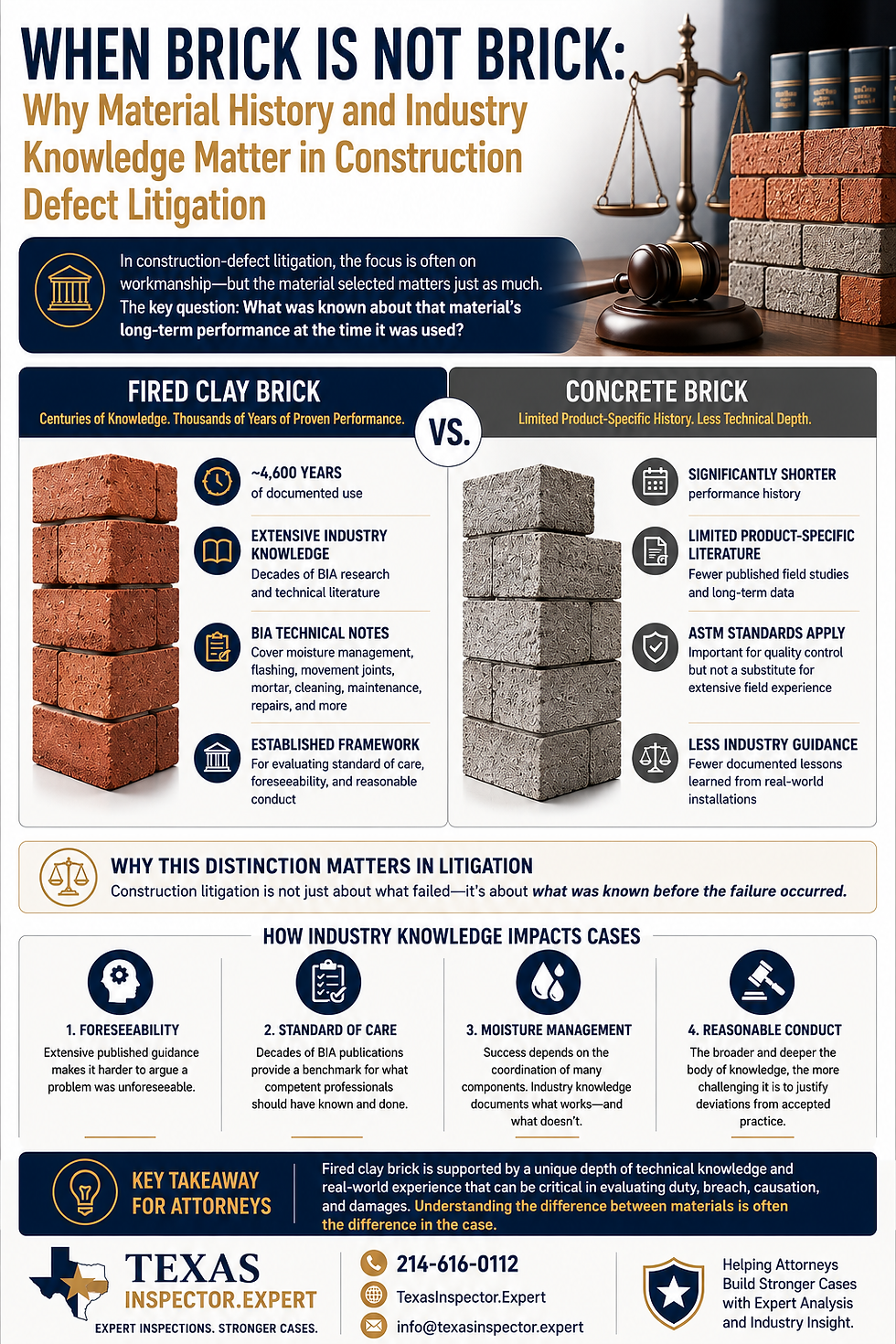
Construction-defect litigation often focuses on workmanship. Experts evaluate flashing installations, movement joints, drainage systems, sealants, mortar, and countless other details that may contribute to a building failure. While workmanship is unquestionably important, an equally significant question is frequently overlooked at the outset of the investigation: What material was selected in the first place, and what body of knowledge existed regarding its long-term performance when that selection was made?
That question has become increasingly relevant as production builders continue to substitute concrete brick for traditional fired clay brick in residential construction. To many consumers, the distinction appears insignificant. Both products are marketed as brick. Both are installed by masons. Both can be manufactured to resemble one another so closely that even experienced observers may struggle to distinguish them from a distance. Yet from the perspective of forensic investigation, standard-of-care analysis, and construction litigation, the differences extend far beyond appearance.
The issue is not whether concrete brick is inherently defective. Nor is the issue whether concrete brick is incapable of providing satisfactory service. Many concrete brick installations will undoubtedly perform adequately for decades. The more important question is whether concrete brick should automatically be presumed equivalent to fired clay brick simply because both products share the word "brick" in their description. For attorneys, that question deserves careful consideration because one material is supported by approximately 4,600 years of documented performance and one of the most extensive bodies of technical literature in the construction industry, while the other is supported by a substantially shorter performance history and a comparatively limited body of product-specific field experience.
The significance of that distinction becomes apparent when examining the role that industry knowledge plays in construction-defect litigation. Courts, experts, and attorneys routinely analyze whether a particular failure was foreseeable, whether accepted preventative measures existed, whether the industry possessed sufficient knowledge to anticipate the problem, and whether the responsible parties acted reasonably in light of the information available at the time. In many respects, construction litigation is not merely a dispute about what failed. It is a dispute about what was known before the failure occurred.
Few building materials possess a body of institutional knowledge comparable to that of fired clay brick. Through the work of the Brick Industry Association (BIA), generations of engineers, architects, researchers, forensic investigators, and masonry professionals have developed an enormous library of technical guidance addressing virtually every aspect of brick masonry performance. BIA Technical Notes discuss moisture management, flashing design, drainage details, movement joints, crack control, mortar selection, cleaning procedures, maintenance practices, repair methodologies, and forensic investigation techniques. Collectively, these publications represent decades of accumulated field experience and lessons learned from both successful installations and documented failures.
This distinction has practical consequences in litigation. When an attorney retains an expert to evaluate a masonry-related failure involving traditional clay brick, that expert is not beginning with a blank slate. Instead, the expert has access to generations of technical guidance that can be used to evaluate whether the design complied with accepted practice, whether the construction incorporated recognized moisture-management principles, whether movement was properly accommodated, and whether known failure mechanisms were adequately addressed. The existence of such guidance does not automatically establish liability, but it frequently provides an objective framework against which conduct can be evaluated.
The importance of this framework cannot be overstated. Standard-of-care opinions are rarely formed in a vacuum. Experts routinely rely upon authoritative publications to support conclusions regarding what competent professionals should have known and what reasonable measures should have been taken. When a failure mechanism has been discussed repeatedly in technical literature, illustrated in published details, and addressed through decades of industry guidance, arguments that the problem was unforeseeable become considerably more difficult to sustain. The existence of extensive BIA guidance therefore affects not only engineering analysis but also questions of foreseeability, negligence, causation, and reasonable conduct.
By contrast, concrete brick does not benefit from an equivalent depth of product-specific literature. Concrete brick products are subject to ASTM standards and applicable masonry design requirements, and those standards play an important role in construction quality. However, there is a substantial difference between compliance standards and a mature technical ecosystem developed through centuries of field performance and decades of dedicated industry research. One of the reasons BIA publications carry such weight within the masonry industry is that they do not merely establish minimum requirements. They document the practical lessons learned from generations of real-world installations.
The distinction becomes particularly important when moisture-related claims arise. Water intrusion remains among the most common allegations in residential construction litigation, and successful moisture management depends upon the coordinated performance of numerous components including flashings, water-resistive barriers, drainage cavities, weeps, sealants, and movement joints. Attorneys evaluating such claims often focus on whether one of these individual components failed. However, the analysis should also include consideration of the selected veneer material and the body of knowledge available regarding its performance characteristics.
The masonry industry's understanding of moisture management in fired clay brick veneer systems has evolved through decades of observation, testing, forensic investigation, and field experience. As a result, BIA publications provide extensive guidance regarding cavity-wall design, flashing placement, weep configurations, drainage principles, mortar collection prevention, and numerous other details intended to control moisture migration. When moisture-related failures occur in clay brick systems, experts frequently have access to well-developed resources that help identify whether accepted practices were followed or ignored. This extensive knowledge base provides a level of analytical certainty that is difficult to replicate when evaluating newer materials supported by a shorter performance history.
Similar considerations arise when investigating cracking, movement-related distress, and long-term deterioration. One of the primary reasons traditional clay brick remains such a well-understood material is that its behavior has been studied for centuries. The industry possesses extensive knowledge regarding thermal movement, moisture expansion, differential movement, crack patterns, expansion-joint design, and numerous other factors that affect long-term performance. BIA Technical Notes and related masonry literature address these issues in substantial detail, providing experts with authoritative references when evaluating whether a particular condition resulted from defective design, defective construction, or normal material behavior.
Perhaps most importantly, fired clay brick possesses something that no modern testing protocol can fully replicate: an extraordinary record of demonstrated performance. Manufacturers routinely rely upon laboratory testing, accelerated weathering programs, and engineering models to predict how products may perform over time. Those tools are valuable, but they remain predictive. Fired clay brick occupies a unique position because its performance is not merely predicted; it has been observed. The masonry industry can point to structures that have survived centuries of environmental exposure while continuing to perform their intended function. That history does not prove that every clay brick installation is superior, nor does it establish that every concrete brick installation is inferior. What it does provide is an unparalleled body of evidence regarding durability, weather resistance, repairability, and long-term service life.
For construction-defect attorneys, the relevance of this historical record extends beyond academic interest. Litigation frequently involves questions regarding reasonable expectations, anticipated service life, long-term durability, maintenance requirements, and the likelihood of future performance. The more extensive the available performance history, the more confidently experts can address those issues. A material supported by thousands of years of documented use and an extensive body of technical guidance offers a fundamentally different evidentiary foundation than a material whose long-term performance remains dependent upon a comparatively limited period of observation.
Ultimately, the increasing substitution of concrete brick for fired clay brick raises a broader question that extends beyond material science. It raises questions concerning what evidence exists to support claims of equivalency, what information was available to industry participants when material selections were made, and what body of knowledge can be relied upon when failures occur. Attorneys handling masonry-related disputes should therefore look beyond the surface appearance of the veneer and consider the depth of historical performance data, technical literature, and institutional knowledge supporting the product itself. In many cases, that body of knowledge may prove just as important as the physical defect that brought the parties into litigation in the first place.


Comments